

The title itself is controversial, simultaneously contradicting and excluding one from the other. However, before I explain to you, based on available literature and my own experience, that this may indeed be possible, let's start with the basics. As an introduction and reminder, I'd like to explain the different types of muscle contractions:
- Eccentric – occurs when a muscle stretches and the proximal and distal attachments (closest and farthest from the body's center) of the muscle move in opposite directions, simultaneously creating tension. This force controls or inhibits the speed of the movement. We are approximately 40-60%(1) stronger eccentrically than we are with 100% of the weight in a concentric contraction. Simply put, we generate more force lowering the weight than lifting it.
- Isometric – also known as static strength. It refers to the contraction of a muscle to produce force without any significant movement. Iso means "the same" and metric means "length." An isometric action can be defined as one in which the proximal and distal attachments of a muscle do not move relative to each other, and the muscle length remains constant. It occurs when the force exerted by the muscle is equal to the force exerted by the load. "Muscle length remains constant" is not 100% accurate. Despite the external lack of movement, tiny, micro-contractions of the muscle fibers occur within the muscle.
- Concentric – a change in muscle tension, along with a change (shortening) in muscle length, that causes movement. A concentric type of muscle contraction occurs when your muscle generates force while actively shortening. Think of the flexion of your lower legs during a lying hamstring exercise.
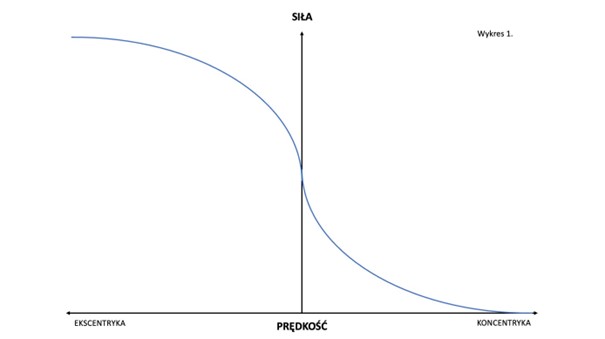
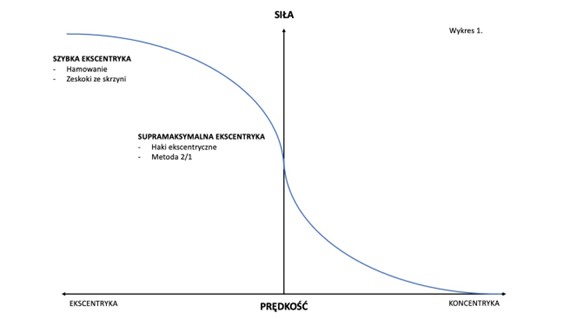
The entire world of training, physical preparation, and fitness is focused on concentricity. On the right side of the force-velocity curve graph (Figure 1). If we search for "force-velocity curve," even Google directs our thinking and training choices... by showing us only the right side of the graph. Many trainers fall into the trap of focusing on training the concentric portion of the graph.
No one wants to watch someone lower the weight during a bench press competition, only lift it. We all want to see someone jump high, not land. We're interested in how fast someone runs, not how quickly they brake. We often build our entire training philosophy around this, focusing on improving concentric contraction. We want to press the gas pedal to the metal every time, forgetting that we also have a brake right next to it. Isometrics are experiencing a renaissance (this will be discussed in one of my upcoming articles), but what about eccentric training? Exactly… Dr. Tim Suchomel, an American scientist, strength training researcher, and student of the legendary Professor Michael Stone, stated in the podcast: Travis Mash's The Barbell Life: Accentuated Eccentric Loading, that eccentric training is very well researched, but many coaches still don't know how to implement it in training. And that's what my post will be about today. I would like to show you the areas in which eccentric training can be used, but above all how to use it in training to build solid athletic performance.
I use eccentric training in five training areas:
- Improving range of motion
- Strengthening tendons and ligaments
- Reducing the risk of injury and rehabilitation
- Hypertrophy training
- Performance improvement
Each of the areas mentioned above could be a comprehensive chapter in any physical preparation book. However, in this article, I'd like to focus on explaining the importance of eccentric training in increasing athletic performance.
So, can we improve our acceleration, maximum running speed, and directional changes using eccentric training tools? Properly conducted eccentric training maximizes the development of physiological properties that reduce the likelihood of injury and increase athletic performance. Eccentric training provides a training stimulus that builds muscles better adapted to explosive athletic movements. In this way, eccentric training significantly improves speed and strength development (2,3). Eccentric training can improve joint stability, increase the efficiency of joint force transfer, and improve braking ability (4,5). If you participate in a sport that involves frequent stopping, acceleration, and directional changes, eccentric training should be a regular part of your program.
P3 is a physical conditioning facility in California, United States, where top NBA players visit. During their stay, they undergo biomechanical testing. One of the players who visits P3 is James Harden, one of the most talented offensive players in the history of the game. However, compared to players like LeBron James or Russell Westbrook, he is neither the tallest, fastest, nor the fastest jumper. P3 creator Dr. Marcus Elliot stated:
"Harden is barely average in almost every metric we look at related to physical performance, except for one... braking, eccentric strength. In that, he's one of the best athletes we've ever measured in any sport—football, football, basketball."
BRAKING = ECCENTRICITY?
What is braking? Definition: "The action performed during a sporting event prior to a change of direction or immediately after a sprint to reduce momentum." – Damian Harper
From a practical perspective, coaches should consider implementing this into their programs. eccentric training , which mainly corresponds to muscle work performed during braking and changes in direction of movement(6).
Strength is task specific, and athletic performance improves when movement time is shorter. – V.Zatciorsky
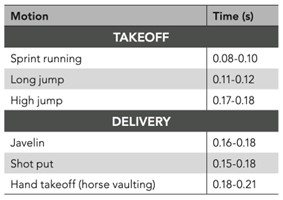
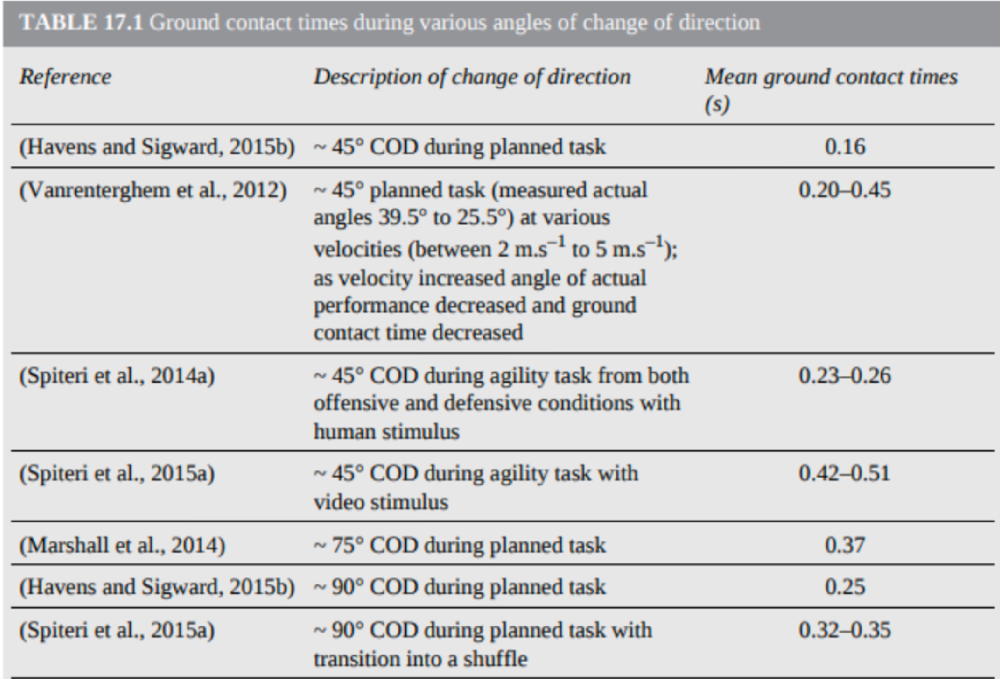
Strength is the mother of all physical abilities. There's no doubt about it. When squatting with a high percentage of your maximum weight, you're not limited in any way by time. Typically, at 90-100% of your maximum weight, the bar moves at 0.15-0.35 m/s, giving you about 0.8-1.5 seconds of work per rep. As the table above from the book shows, The Science and Practice of Strength Training Vladimir-M.-Zatsiorsky William J. Kraeme , during basic athletic activities such as running, jumping, or throwing, to achieve high athletic performance, we need to demonstrate our strength as quickly as possible—up to 10 times faster during sprinting! The same applies when braking and changing directions at various angles. The table from chapter seventeen of the book Advanced Strength and Conditioning by A. Turner, P. Comfort illustrates this phenomenon. In short, the smaller the angle of change in direction, the shorter the ground contact time. We need a high rate of force development. Strength is as important as the ability to utilize it.
One of the most important "WHYs" for implementing eccentric training in training programming is precisely the changes in direction of movement and braking (which is a component of changes in direction). In many sports, changes in direction of movement are the most important KPIs (and key performance indicators). In fact, every dynamic movement begins with eccentric muscle action.
For example, during a jump, before you take off, your hips drop slightly, eccentrically lengthening your quadriceps and glutes before the jump. This counteraction is crucial for energy production. The eccentric phase triggers a series of events that pre-load the muscles, thus storing energy for use in concentric and dynamic movement. When you train eccentrically, you're actually developing two physiological processes that contribute to muscle strength development. The first is the stretch reflex, and the second is called the stretch-shortening cycle (SSC).
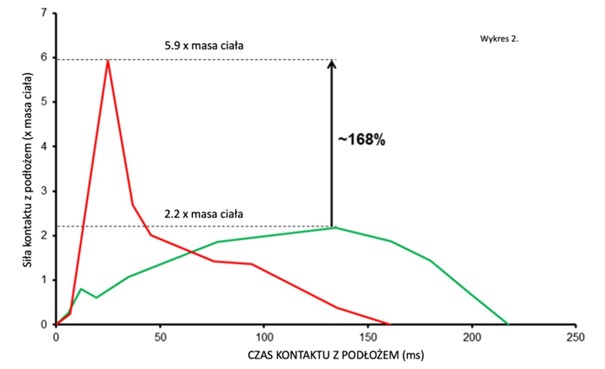
From a biomechanical perspective and the force exerted on our body relative to the ground, our body must absorb 5.9 times our body weight during braking, which is 168% more than during acceleration (Figure 2)(7). Eccentric contraction of the quadriceps, glutes, hamstrings, and shins are strongly correlated with braking and changes in direction(8). Low levels of eccentric force during braking can cause ACL damage(9).
BASIC LAWS OF PHYSICS IN ECCENTRIC TRAINING
To better understand the "phenomenon" of athletic performance: acceleration, deceleration, sprinting, we should know at least a little about the laws of physics, at least at a basic level. Many people believe that the world is governed by Newton's three laws of motion. Strength is a word used in the strength community, without full understanding. So what is strength? It's a simple question that's incredibly difficult to answer. As Dan Cleather states in his book Force : "Force is an attempt to describe why things move. Force actually describes changes in motion." This can be seen in Newton's laws:
-
Newton's law of dynamics (inertia): If a body is not acted on by any other bodies, or if the actions of other bodies are balanced, then the body remains at rest or moves with uniform rectilinear motion.
-
Newton's law of motion (F=ma): If a constant resultant force acts on a body, the body moves with uniformly accelerated motion with acceleration directly proportional to the acting force and inversely proportional to the mass of the body.
-
Newton's law of dynamics (action and reaction): The interaction of two bodies is always reciprocal. If one body exerts a force on another, the second body exerts a force on the first body that is equal in magnitude and opposite in direction.
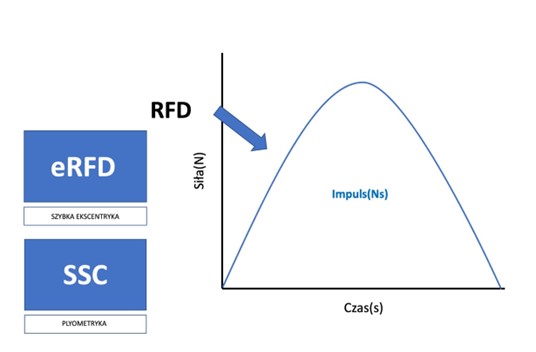
Newton's second law of motion can be used to formulate momentum (force impulse), also known as impulse. Motion, in some form or manner, revolves around a body and its collision with the environment. At the simplest and most basic level, the descriptor of this collision is impulse. Impulse measures the relationship between force and time.
From the point of view of physics, impulse is described by the same formula as momentum:
I=mx v or p=mx v
From a graphical point of view it looks like this (chart 3):
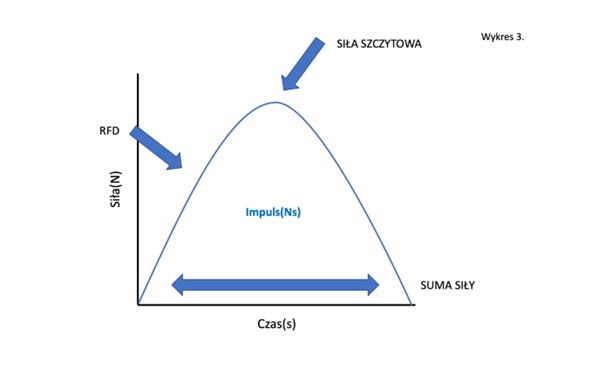
The human body moves by applying impulse in specific vectors. The level of impulse and the direction in which it is applied determine both deceleration and acceleration. Impulse can therefore be positive (acceleration) or negative (deceleration). In sports, momentum and the ability to control it are extremely important. The speed at which an athlete can accelerate and decelerate is a direct indicator of the generation and application of impulse and the control of momentum. Therefore, deceleration can be said to be "negative" acceleration.
The magnitude of the impulse isn't the only factor determining training success. The direction of this impulse will determine whether we accelerate or decelerate. This depends on the location of force application and the angular values during the execution of a given exercise. Charles Poliquin, a Canadian strength coach, used to say: "Strength is gain in the range of the motion you train." The direction of force application will also determine muscle contraction. Acceleration is primarily concentric. Deceleration and deceleration will be primarily eccentric in nature due to the direction of force.
HOW MUCH ECCENTRIC TRAINING
Charles Poliquin believed that the optimal annual training cycle ratio should be 10-20% isometrics, 20-30% eccentrics, and 60-70% concentrics, depending on the sport being practiced and the athlete's strength deficit. But let's look at it from a different perspective. If you look at GPS charts for most team sports, the acceleration-to-deceleration ratio will be around 3:1, meaning there's three times as much acceleration during the game! However, when we return to the second chart, we notice that the ground contact force multiplied by body mass is three times greater than during acceleration. Therefore, although there's three times less deceleration than acceleration, the amount of load "imposed" on the body is three times greater. Therefore, we can assume that the amount of work, its ratio, will be 1:1!
FORCE-VEHICLE CURVE
During eccentric contractions, the force-velocity relationship is the opposite of that for concentric work (10). In fact, to produce high levels of force, muscles must lengthen rapidly, not slowly!
- High concentric force = low speed - Low concentric force = high speed
- High eccentric force = high speed
- Low eccentric force = low speed
For example, jumping off a 40 cm box produces ground reaction forces of 4.4 x body weight(11).
Knowing that eccentric forces (e.g., braking) during athletic activities are significantly greater than concentric forces, we should train them in the same way we train the right side of the force-velocity curve. A certain level of eccentric reserve should be built up under controlled training conditions so that during athletic competition and accumulated fatigue, the body can cope with the magnitude of forces acting on our bodies.
The ability to brake during dynamic sports movements is one of the most overlooked physical skills in training. Many coaches focus too much on developing speed, acceleration, and jumping ability, forgetting the other side of the velocity curve. Sprinting is the component between braking – the eccentric phase (foot contact with the ground), shock absorption – the transfer between eccentric and concentric (isometric), and propulsion (concentric phase).
Eccentric Training, Methods and Their Programming
Athletes who generate greater braking forces are able to accelerate into a new running direction earlier, allowing them to change direction more quickly. Furthermore, faster athletes achieve shorter ground contact times compared to slower athletes. Research has shown that shorter braking times can enable a faster transition to the acceleration phase of movement, increase the application of acceleration force, and improve performance during changes in direction (12).
The end goal of any training program in 90% of all sports is to improve SSC and "transfer" maximal force to high-speed movements (RFD). Some level of eccentric muscle stretching and elastic energy storage is likely necessary to achieve powerful propulsion through SSC(13).
So how do we create a training plan to achieve this goal? We know we need a high level of eccentric strength, but we also need to demonstrate this strength as quickly as possible. Deceleration is a time-dependent movement. To generate high impulse, we must remember to develop peak strength:
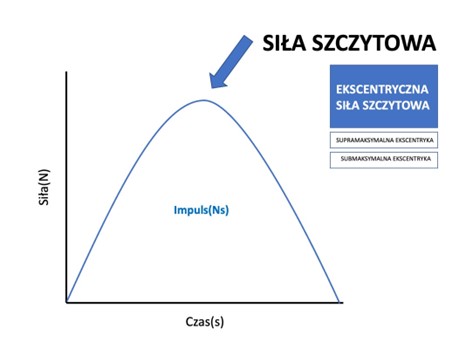
But also the pace of development of this force:
Albert Einstein used to say: If you can't explain something simply, you don't understand it well enough. I believe that in my environment, we often complicate things that don't need to be complicated. Below, I present the progression of the methods I use in my practice.
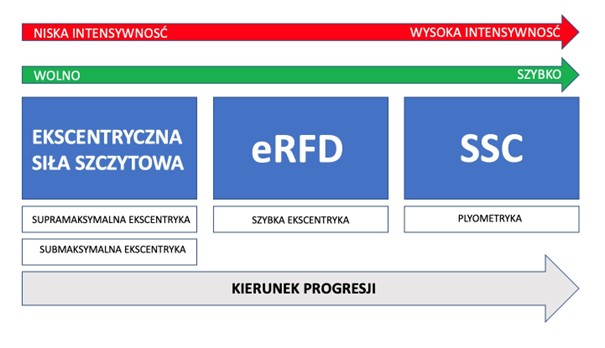
In the next article, I will present each of the above-mentioned methods in detail and show you how to apply them in your training plans.
Regards,
Artur Pacek

Artur Pacek – Physical preparation coach. Recognized as the country's foremost specialist, he is an expert in periodization, combining training stressors, and developing muscle strength and power in team sports using three types of muscle contractions: eccentric, isometric, and concentric.
Bibliography:
-
Application of Accentuated Eccentric Loading to Elicit Acute and Chronic Velocity and Power Improvements: A Narrative Review. J. Merrigan, J. Borth, T. Suchomel, et al. International Journal of Strength and Conditioning. 2022.
-
Douglas J., Pearson S., Ross A., and McGuigan M. “Chronic Adaptations to Eccentric Training: A Systematic Review.” Sports Medicine . 2017.
-
Friedmann-Bette B., Bauer T., Kinscherf R. et al. “Effects of strength training with eccentric overload on muscle adaptation in male athletes.” European Journal of Applied Physiology . 2010.
-
Papadopoulos C., Theodosiou K., Bogdanis GC, et al. “Multiarticular Isokinetic HighLoad Eccentric Training Induces Large Increases in Eccentric and Concentric Strength and Jumping Performance.” The Journal of Strength & Conditioning Research . 2014.
-
Roig M., O'Brien K., Kirk G., et al. “The effects of eccentric versus concentric resistance training on muscle strength and mass in healthy adults: a systematic review of meta-analysis.” British Journal of Sports Medicine . 2009.
-
Change of Direction Tasks: Does the Eccentric Muscle Contraction Really Matter? Helmi Chaabene
-
Biomechanical and Neuromuscular Performance Requirements of Horizontal Deceleration: A Review with Implications for Random Intermittent Multi-Directional Sports. D. Harper, A. McBurnie, T. Dos' Santos.
-
Behan FP, Pain MTG, Folland JP. Explosive voluntary torque is related to whole-body response to unexpected perturbations. J Biomech. 2018.
-
Systematic video analysis of ACL injuries in professional male football (soccer): injury mechanisms, situational patterns and biomechanics study on 134 consecutive cases F. Della Villa, M. Buckthorpe A. Grassi
-
Eccentric and concentric torque-velocity relationships during arm flexion and extension. Influence of strength level. T Hortobágyi 1, F I Katch. European Journal of Applied Physiology. 1990.
-
A Methodological Approach to Quantifying Plyometric Intensit Mark M Jarvis 1, Phil Graham-Smith, Paul Comfort. 2016. The Journal of Strength & Conditioning Research
-
Mechanical Determinants of Faster Change of Direction and Agility Performance in Female Basketball Athletes. Spiteri, Tania1; Newton, Robert. Journal of Strength and Conditioning Research. 2015.
-
Kinetic demands of sprinting shift across the acceleration phase: Novel analysis of entire force waveforms. L Colyer, R Nagahara 3, A IT Salo.

